22/10/2026 09:02
Real Room or Digital Mock-up? YouTube AI Disclosure Checks for Cambodian Rattan Shops

A beautifully staged room can help shoppers imagine a rattan chair in their home. It can also create expectations that the physical chair cannot meet. An AI-generated interior might change the weave, widen the seat, invent a cushion or suggest that a Cambodian shop completed an installation that never happened. Before promoting that video, the owner needs to answer a practical question: which parts show the product, and which parts illustrate an idea? This workflow explains how to review mixed footage, make an appropriate YouTube disclosure, and keep SMM-panel decisions separate from evidence about the furniture. Every business scenario below is hypothetical, and the accompanying images are AI-generated editorial illustrations.
1. Decide what the room scene should help buyers understand
Start with a buying question rather than a request for a more impressive video. A shopper might need to understand how a curved chair looks beside a small table, whether its arms fit beneath their tabletop, or which cushion is included. A room concept can support a discussion about style. It cannot establish clearance, load capacity, material composition or available stock.
In a hypothetical Phnom Penh rattan shop, the owner wants to promote an armchair to people furnishing compact sitting areas. The useful creative brief is to show the chair clearly, illustrate one possible arrangement, and invite buyers to check dimensions. Asking an editor to make the product look luxurious is less precise. It encourages decorative changes without identifying which product details must survive the edit.
2. Build a shot inventory before reviewing the finished edit
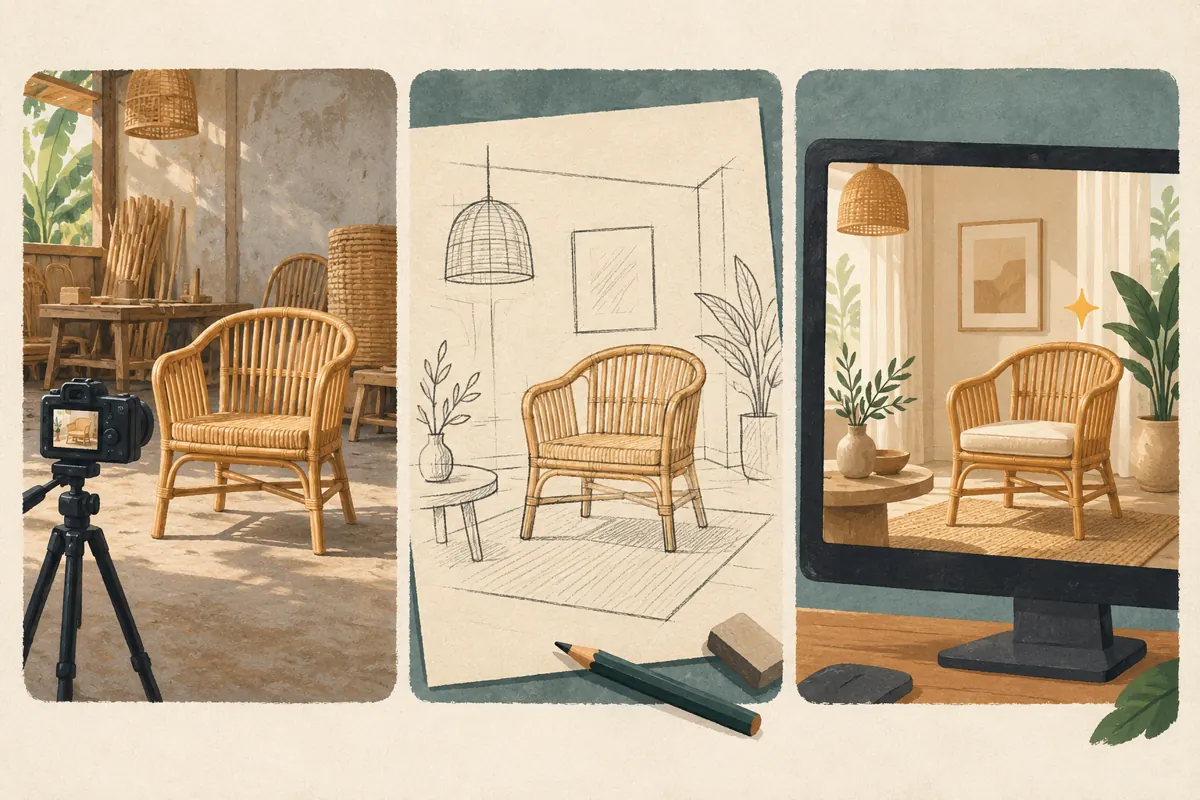
Ask the editor to identify the origin of each scene: camera footage, a conventional drawing, an AI-generated image, or footage changed with generative tools. Record the scene's position, its source and what changed. Include still images that have been animated into moving shots. Movement does not turn an invented room into a filmed location.
Keep the inventory simple enough to maintain. For example, describe one scene as workshop footage of the current chair and another as an AI room concept based on a product photograph. Add any uncertain elements, such as whether the tool reconstructed the chair legs. Review transitions too: a direct cut from a real workshop to a realistic invented apartment can imply that the shop delivered the chair there, even when nobody explicitly says so.
3. Apply YouTube's disclosure rule to the actual scene
YouTube requires disclosure for realistic AI-generated or meaningfully altered content, including realistic scenes that did not occur. Minor aesthetic changes and clearly unrealistic content generally do not require disclosure. During upload, its current guidance directs creators to Attributes and the AI use setting. Select the answer that matches the content. See YouTube's [Disclosing use of GenAI content](https://support.google.com/youtube/answer/14328491?hl=en) guidance.
Applying that rule to our hypothetical shop, a convincing generated apartment containing the chair should be treated as a realistic invented scene. A visibly hand-drawn furniture arrangement presents a different case. Make the decision from the exported video, because an early sketch may have become a realistic render during editing. Keep a short explanation beside the shot inventory so the person uploading understands the choice.
4. Compare the generated chair with the physical product
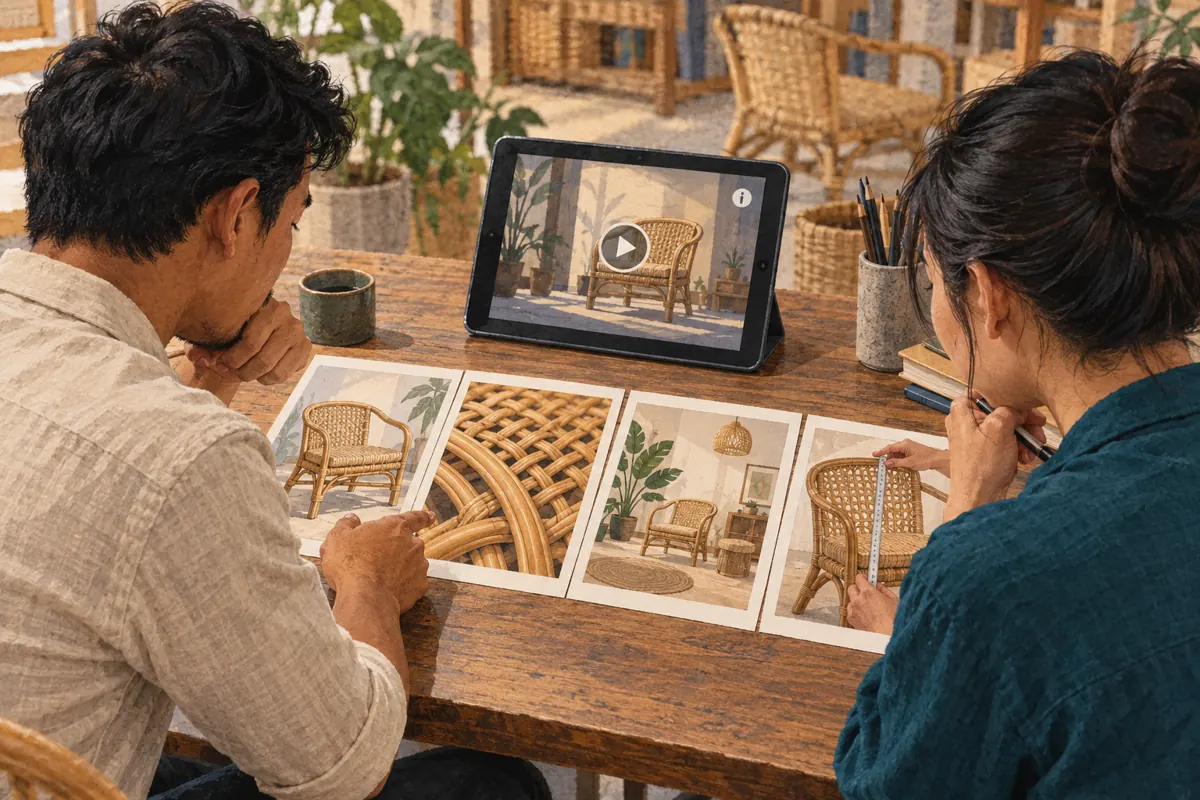
Pause each generated scene and compare it with fresh reference photographs. Check the silhouette, arm shape, back height, weave pattern, leg arrangement and visible joints. Look for added supports, missing bindings or cushions that become thicker between frames. A room image can look coherent while quietly depicting a different chair. If the mismatch affects a buying decision, regenerate the scene, replace it with a drawing or remove it.
Then check what the setting implies. A chair placed beneath a table can suggest a comfortable fit, although the scene has no reliable scale. A pale generated finish may look like a stocked colour that the shop does not sell. Use actual measurements and material samples for those questions. Do not attach precise dimensions to a generated perspective unless they come from independently checked product information.
5. Explain the mock-up where viewers encounter it
A platform disclosure identifies AI use, but the shop still needs to explain the commercial meaning of the scene. In the hypothetical video, a short spoken and visible note could say: AI room concept; arrangement shown for inspiration. Follow it with actual product footage. If the cushion or table is a styling suggestion, explain that separately rather than expecting viewers to infer what is included.
Write the note in the language the intended customers understand. For a Khmer-speaking audience, have a fluent reviewer check that the wording means an imagined arrangement, not a completed customer installation. Keep the note legible on a phone and visible long enough to read. Avoid a tiny disclaimer that disappears before the generated room appears. The viewer should not have to search through unrelated information to understand the scene.
6. Construct a video that returns to verifiable details
A useful sequence begins with the actual chair, moves to the room concept, then returns to the product. Show the front and side views, the woven surface and the arm clearance being measured. Introduce the imagined setting only after viewers understand which physical item is for sale. Finish with the information needed for a genuine enquiry, such as the model reference and which room measurements to send.
For the hypothetical compact-room campaign, the editor might use the concept to explain placement beside a reading table. The next shot should show the real arm height and overall width. This gives the buyer a way to test the suggestion against their own space. Avoid using an invented person sitting comfortably in the chair as evidence of comfort, strength or suitability; those claims require a different basis.
7. Check the promise made by the title and thumbnail
Review the title, thumbnail and opening sentence together. A title such as A Rattan Chair Arrangement for a Small Sitting Area frames the video as an idea. A claim about a completed apartment installation needs evidence of that actual project. Even an accurate disclosure later in the video cannot make an invented customer story a sound marketing choice.
For the hypothetical shop, using a clear photograph of the real chair as the thumbnail may make the product easier to recognise. If the creative team chooses a room concept instead, make its illustrative purpose understandable. Check that decorative accessories do not appear to be a bundled offer. Also compare any close-up thumbnail crop with the video: the weave, cushion and finish should describe the same item.
8. Review the SMM service independently of the creative
The supplied catalogue includes the exact listing “YouTube Subscriber ~ Max 100k ~ 50-100/days ~ Instant ~ 𝗥𝗘𝗙𝗜𝗟𝗟 30D”. Its title identifies a subscriber-related offer, but no supporting description was supplied. The title alone does not establish its delivery method, policy compliance, audience location or whether subscribers have any interest in rattan furniture. Treat its timing and refill wording as unverified listing claims.
YouTube prohibits artificial increases in engagement metrics and says a hired promoter's actions can affect the channel. Review the method before authorising a service; do not proceed with artificial engagement. See the official [Fake engagement policy](https://support.google.com/youtube/answer/3399767?hl=en). An AI disclosure does not make an engagement method acceptable, and an SMM order does not verify the product shown. Purchased engagement is not evidence of genuine interest, sales, ad delivery or Cambodian users.

9. Give the editor a concrete approval boundary
The owner should approve more than a pleasing final frame. Review the product references, shot inventory, disclosure decision and exact customer-facing explanation together. Specify which changes require another review: replacing the chair, changing the finish, adding an included accessory, inventing a person or substituting a different room scene. These changes can alter what the video communicates even when its length stays the same.
In the hypothetical shop, the owner approves the actual chair footage and one clearly identified room concept. Later, the editor adds a generated family gathering around the furniture. That addition needs review because it introduces people and an apparent usage scenario beyond the approved arrangement. Keep the approved export distinguishable from drafts, and give the uploader its precise reference so an earlier, unexplained version is not selected accidentally.
10. Test understanding before expanding promotion
Ask someone unfamiliar with the project to watch the finished video on a phone. Then ask what is actually for sale, whether the room is real, which accessories are included and what they would check before ordering. Their answers can expose ambiguity more effectively than asking whether the video looks attractive. Treat this as an informal comprehension check, not a representative customer survey.
After publication, keep a small record of genuine questions. Repeated requests for the pictured table may suggest unclear styling boundaries. Questions about visiting the apartment may indicate that the concept looks like a real installation. Correct the explanation and review the creative before distributing it further. A rising view count cannot tell you whether buyers understood the distinction, and a quiet comment section cannot establish that they did.
11. Avoid shortcuts that turn illustration into a product claim
Common mistakes include labelling only the description, assuming a generated product remains unchanged, and accepting an editor's assurance without watching the exported scenes. Another is using a room concept to answer a fit question. If a buyer asks whether the chair clears a particular doorway, respond with checked dimensions and a practical measuring instruction. The attractive room image does not resolve that question.
Also avoid presenting synthetic people as customers or imagined rooms as completed work. Keep authentic project photographs, with appropriate permission, separate from concepts in the content library. When a generated visual creates more explanation than value, use a straightforward drawing or film the chair in a simple setting. The best creative choice is the one that helps a prospective buyer understand the offer and decide what to ask next.
Frequently asked questions
Does every use of AI require a YouTube disclosure?
No. YouTube distinguishes realistic generated or meaningfully altered content from minor edits and production assistance. Evaluate the actual video rather than simply noting that an AI tool was involved. For this furniture workflow, a realistic invented room deserves particular attention. Refer to the official guidance linked above when deciding.
Can a real chair photograph be placed inside an AI-generated room?
It can be a useful concept, provided the result is accurately explained and appropriately disclosed. Check whether the process changed the chair itself. Keep a real product view nearby in the sequence, and avoid implying that the surrounding room, accessories or installation belong to an actual customer.
Is an AI label enough if the generated chair has the wrong weave?
No. The label explains how content was made; it does not correct an inaccurate product representation. Replace or repair the scene, then compare it again with the actual chair. If the weave is central to the offer, use genuine close-up footage to show it.
Should the shop remove the disclosure to improve reach?
No. YouTube says disclosure alone does not limit audience or monetisation eligibility. Keep the required disclosure and improve the video's usefulness instead. Clear product views, understandable explanations and a relevant buying question give the team concrete things to improve without hiding how the scene was created.
Can subscriber purchases show that Cambodian buyers like the room concept?
No. A service record cannot establish viewers' location, purchase intent or understanding. It also requires a separate policy review. Use genuine enquiries and carefully documented customer feedback to learn which details need clarification, while recognising that a few responses do not represent the whole market.
Explore the current service catalogue, create an account, or ask a specific question through support tickets.
Prepared with AI assistance. Illustrations explain the workflow and do not represent customer results.