19/10/2026 13:54
Before the First Message: A Telegram Start-Page Workflow for Cambodian Shoe Repair Shops
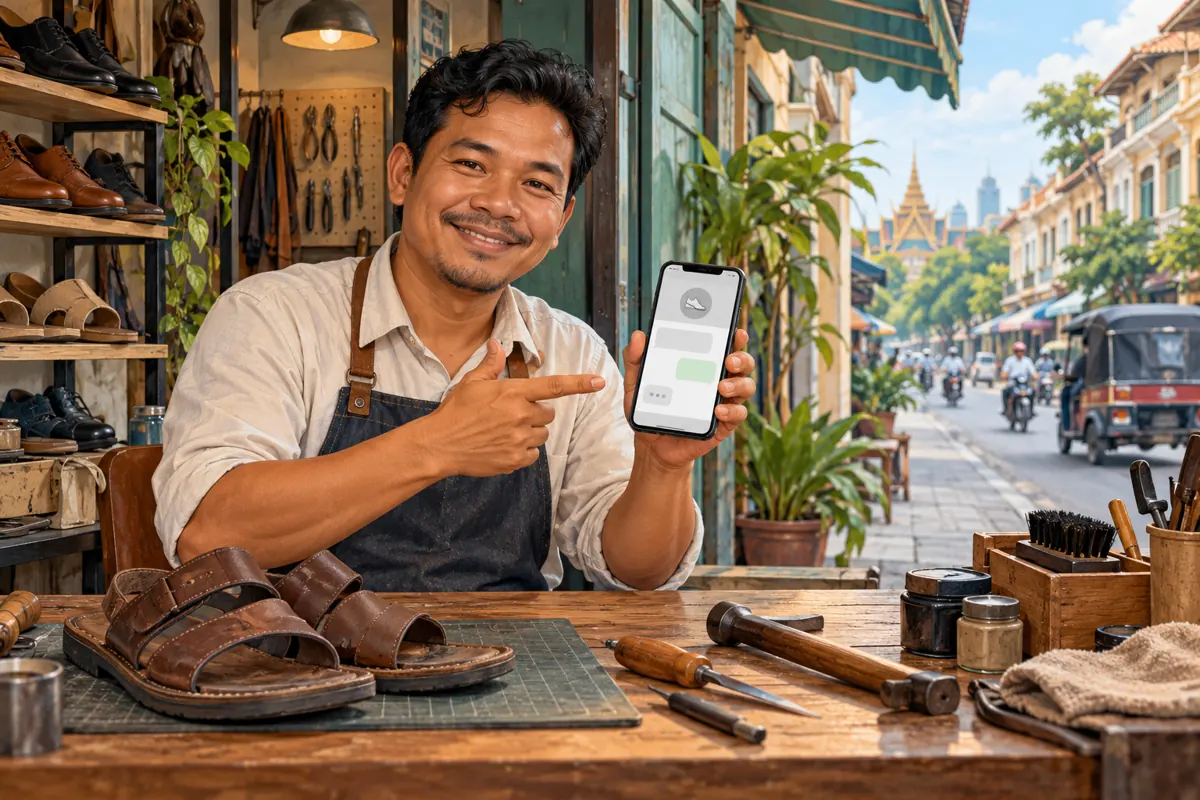
A customer sees a sandal repair demonstration, opens the shop’s Telegram chat and hesitates. Should they send a photograph, ask for a price or visit with the damaged shoe? Promotion has brought them to a conversation, but the next step remains unclear. For a Cambodian shoe repair business, a useful welcome can address that uncertainty before the first message arrives. This guide explains how to plan a Telegram Business start page around one manageable request, test it and connect it with honest promotion decisions. The shoe repair shop and customer situations below are hypothetical examples, not testimonials or evidence of results. The objective is a clearer enquiry process; neither a welcome screen nor purchased engagement establishes demand or guarantees bookings.
1. Give the empty chat one clear job
Telegram’s official Business announcement describes a customizable start page for empty chats, where businesses can choose introductory text and a sticker. Its practical purpose here is to help someone begin. A greeting message is a different feature, sent after a person contacts the business under the configured conditions. Plan the start page as the sign beside your digital entrance: it should explain what this shop handles and what the visitor can send next.
For a hypothetical Phnom Penh shoe repair counter, choose a narrow first task: request an initial assessment of a damaged shoe. Do not crowd the welcome with every service, delivery arrangement and payment condition. Write down the question the screen must answer: ‘What should I send so the shop can understand the problem?’ If your draft does not answer that, decoration and extra promotion will not repair the gap.
2. Check the account and feature before writing
Telegram’s Business documentation lists these features as available to Premium subscribers. Check the current options in Settings > Telegram Business on the account customers actually contact. Confirm that the start-page control is available before planning around it. Menu wording can differ across clients, so use the visible controls rather than following an assumed screen layout. This workflow requires no bot development or account access for an outside service provider.
Decide who maintains the introduction and who answers incoming repair questions. In a small workshop, these may be the same person. Where a family member handles promotion, have the repairer approve the service scope first. A shop that repairs loose soles but does not replace specialized sports-shoe components should not welcome every visitor with an unrestricted repair promise. If the feature is unavailable, put the essential enquiry instructions in your promotional caption while you assess whether a subscription is useful.
3. Ask for information that changes the next decision
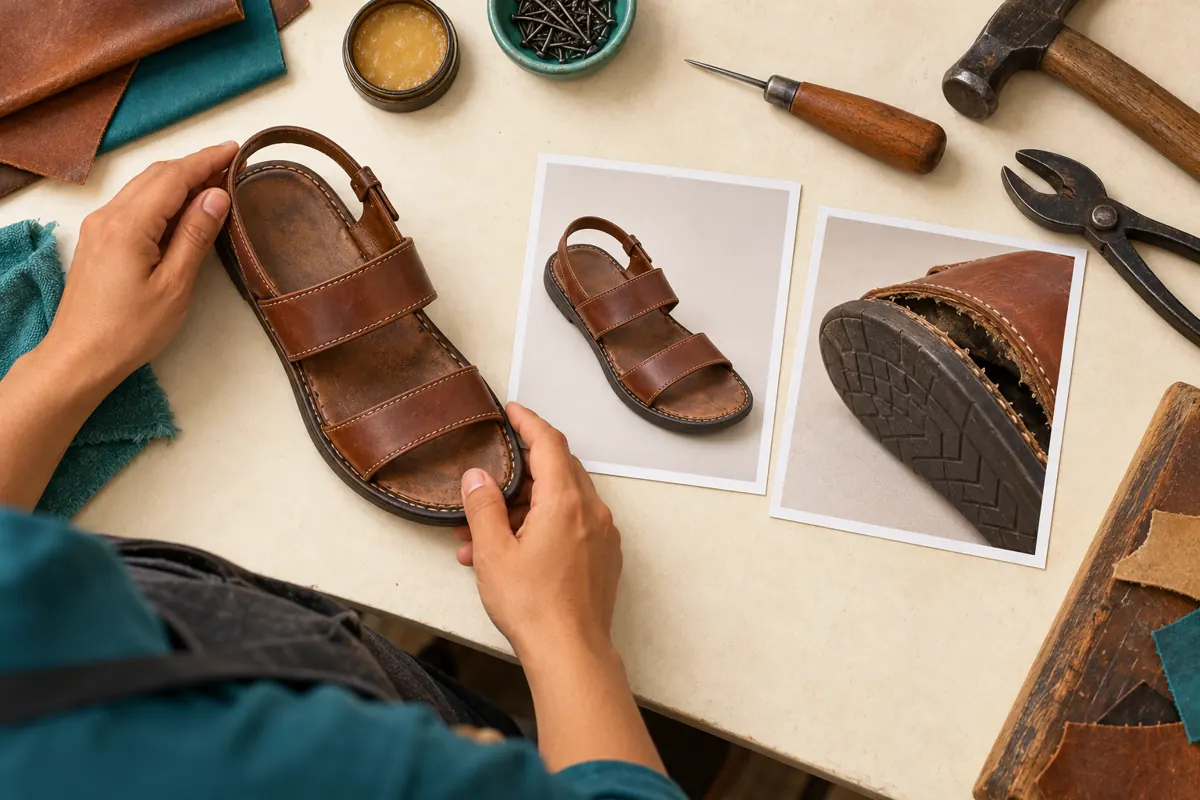
Start with the smallest useful request. For shoe repairs, an overall photograph identifies the item, while a close view helps locate the damage. Ask the customer to describe the problem briefly. A preferred completion date may matter when deciding whether to invite them for an inspection. These details serve different purposes; asking for several nearly identical photographs creates work without necessarily making the enquiry clearer.
Keep the first contact proportionate. A full home address, identity document or payment screenshot is unnecessary for understanding a detached sole. If collection becomes relevant later, request the required location details privately at that stage. Offer a simple alternative for customers who struggle to send photos: they can describe the problem or ask about bringing the item in. Treat the welcome as guidance, not an admission form that prevents someone from asking an ordinary question.
4. Draft a short introduction with an honest boundary
A hypothetical English draft could read: ‘Shoe repair enquiries. Please send a photo of the whole shoe and a close view of the damage. Tell us what happened and when you need it. We confirm repair options and price after assessment.’ Adapt this to the shop’s actual process. If physical inspection is always required before quoting, say that explicitly instead of allowing ‘assessment’ to imply that photographs are sufficient.
Use the language your customers can comfortably act on. A Cambodia-facing shop may choose Khmer for its customer introduction, with a compact English version if its audience needs one. Have a fluent colleague review practical terms such as sole, heel and stitching. Avoid squeezing two long versions into a small space. Read the draft aloud and remove anything that does not help someone identify the service, prepare an enquiry or understand the next decision.
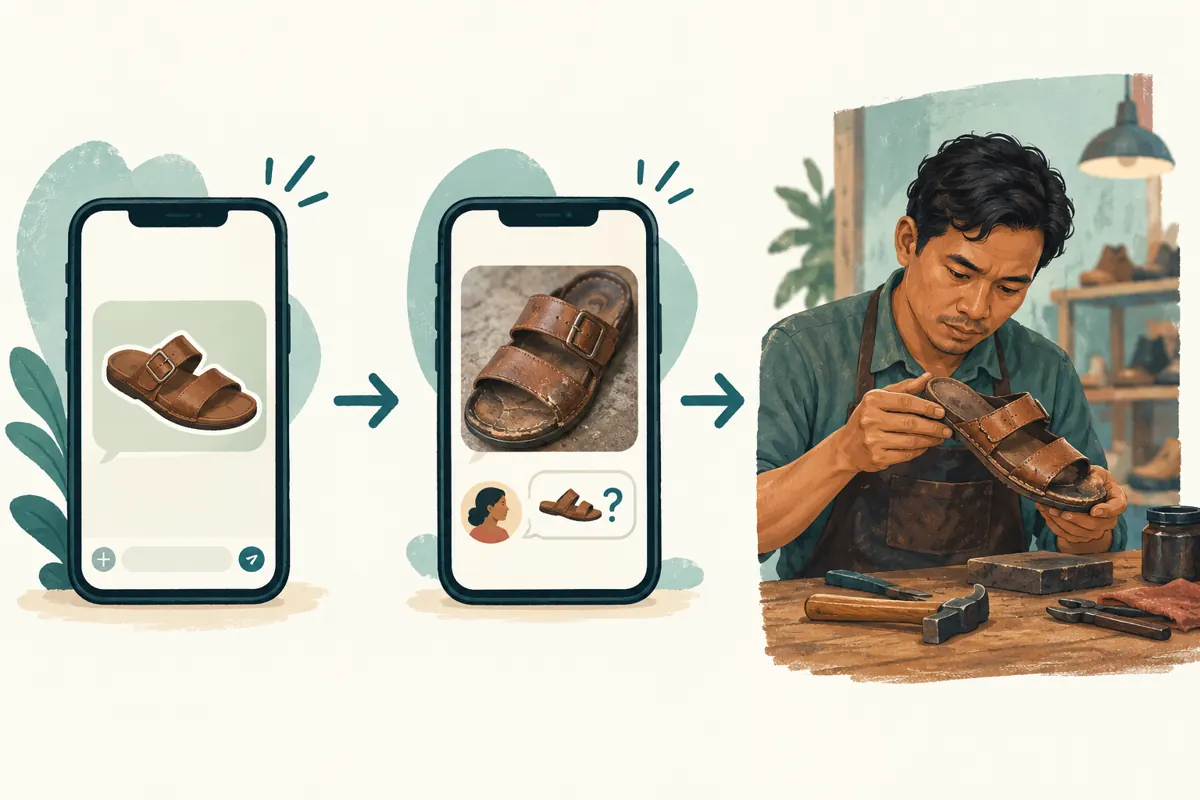
5. Make the artwork support the instruction
Telegram’s documented business introduction contains a title, a description and an optional sticker. A simple shoe illustration can help a visitor recognize the business category. Choose artwork that remains understandable at a small size. A detailed repair-price poster, a collage of tiny products or a sticker carrying paragraphs of instructions makes the visitor work harder. Put essential instructions in the text fields, where they can be reviewed directly.
Use artwork you own or have permission to use. A friendly illustrated sandal is sufficient; it does not need a badge implying certification, platform approval or customer satisfaction. Avoid before-and-after imagery that could be mistaken for a repair your shop actually completed unless you can substantiate that context. The illustrations accompanying this guide are explanatory scenes, not customer evidence. Apply the same distinction to graphics used in your own promotion.
6. Test the welcome with a first-time visitor
Save the introduction and ask a willing colleague with no existing conversation with the business to review the empty-chat experience. An established customer thread is a poor test of a feature intended for empty chats. Do not erase useful customer history just to create a test. Check the published account through the same public route a prospective customer would use, such as the contact destination in an approved promotional post.
Give the tester a practical task: ‘Your sandal strap is loose. Show me what you would send.’ Observe without explaining the welcome first. Can they identify the requested photographs? Do they think a price or completion time is already promised? Can they distinguish a preliminary enquiry from an accepted repair? Record the confusing phrase, revise that phrase and test again. A successful technical save does not establish that the instructions make sense to a visitor.
7. Connect promotion to the same enquiry
Build a promotional post around a problem the workshop genuinely handles. For example, a hypothetical demonstration might show how the repairer examines a separating sole before deciding what work is appropriate. Close with an invitation to send clear photographs for an initial discussion. The post and the start page should ask for compatible actions. A caption promising an immediate fixed price conflicts with a welcome explaining that inspection is required.
Review the complete journey on a phone: demonstration, contact destination, empty-chat introduction and first response. Keep recognizable shop details consistent so visitors can tell they reached the intended business. Avoid directing viewers to a catalogue channel when the caption promises a private repair enquiry unless the route onward is clearly explained. Choose a promotion volume the shop can answer; attracting more questions while leaving existing enquiries unresolved can create a service problem.
8. Decide whether an SMM listing fits this task
The supplied KhmerBoosting catalogue includes the exact listing ‘Telegram - Channel/Group Members ~ Max 1M ~ 𝐍𝐎 𝗥𝗘𝗙𝗜𝗟𝗟 ~ 50k/days ~ INSTANT’. Its category identifies bot-account members, and its separate description is empty. The supported distinction is that this is a channel/group member listing. It is not a documented start-page setup service or a service for obtaining shoe-repair enquiries. Treat the capacity and timing wording as catalogue claims, not verified outcomes.
Ask what problem a proposed purchase would solve. If visitors do not know which photographs to send, revise the introduction. If enquiries arrive but remain unanswered, improve the response routine. Adding channel or group members does not resolve either issue. Purchased engagement is not evidence of genuine interest, sales, advertising delivery or Cambodian users. For this workflow, skipping a mismatched service is a sensible decision. Do not infer an available private-chat enquiry service from a member listing.
9. Review enquiry quality without inventing a success story
Keep a brief, private review note about recurring communication problems. Useful observations include missing damage photos, uncertainty about whether the shop handles the item and confusion about when a price becomes final. Record only the detail needed to improve the instructions. There is usually no reason to copy customer photos or identifying information into a general marketing report.
Compare the questions you receive with the task the welcome was designed to support. If customers consistently send only close-ups, try clarifying why an overall photograph helps. If they assume the repair is booked, strengthen the assessment boundary. Do not attribute a change in enquiries solely to the start page: the demonstration, season, customer mix and staff replies may also have changed. A useful conclusion is specific and limited, such as ‘We revised the photo instruction after repeated clarification requests.’
10. Prevent common mistakes and maintain the welcome
The most common mistake is treating the introduction as a miniature sales brochure. Long service lists bury the first action. Another is promising speed that the workshop cannot consistently provide. Avoid ‘instant quote’ or ‘same-day repair’ unless those statements accurately describe the relevant service and conditions. A welcome should not convert uncertainty about materials, damage or workload into an apparent commitment.
Review the wording whenever the shop changes its repair scope or assessment process. Assign an owner to check that the welcome still matches promotional captions and the replies staff actually send. Keep temporary details, such as a short closure or a changing collection arrangement, in the appropriate customer communication rather than relying on an empty-chat introduction to inform everyone. Existing customers need relevant updates too. Finish each review by testing the next action a new visitor is being asked to take.
Frequently asked questions
Is a Telegram start page the same as an automatic greeting?
No. Telegram describes the start page as an introduction shown in empty chats before a conversation starts. Greeting messages are a separate automated response feature. Use the introduction to help the visitor begin, and avoid making any later greeting repeat a long set of identical instructions.
Can the shop quote a repair price from the requested photos?
That depends on the repair and the shop’s assessment process. Photographs may clarify the problem while leaving material condition or hidden damage uncertain. State whether a response is preliminary and identify what must happen before the price is confirmed. The welcome itself should not imply acceptance of the job.
Will buying Telegram members bring local repair customers?
A member purchase does not establish local demand or generate evidence of customer intent. The relevant supplied listing concerns channel/group members and is categorized as bot accounts. It provides no supported basis for promising Cambodian repair enquiries, private conversations or sales. Evaluate each genuine enquiry on its own merits.
What should we change if visitors still send only ‘Hello’?
Reply helpfully and request the missing information. Review whether the welcome is too long, uses unfamiliar repair terms or asks for too much at once. Some customers will prefer to begin conversationally regardless of the instructions. Judge the welcome by whether it helps people, not by whether everyone follows an identical script.
Should the introduction include payment instructions?
Usually the first task is understanding the repair, so payment instructions can wait. Explain assessment and any legitimate inspection charge at the appropriate point before the customer commits. Keeping payment separate from the initial photo request reduces the chance that an enquiry will be mistaken for an accepted order.
Explore the current service catalogue, create an account, or ask a specific question through support tickets.
- Telegram: Introducing Telegram Business
- Telegram Business technical documentation
- Telegram: Business introduction fields
Prepared with AI assistance. Illustrations explain the workflow and do not represent customer results.