22/10/2026 00:40
Which Lunch-Bag Question Should You Film? TikTok Search Research for Cambodian Shops
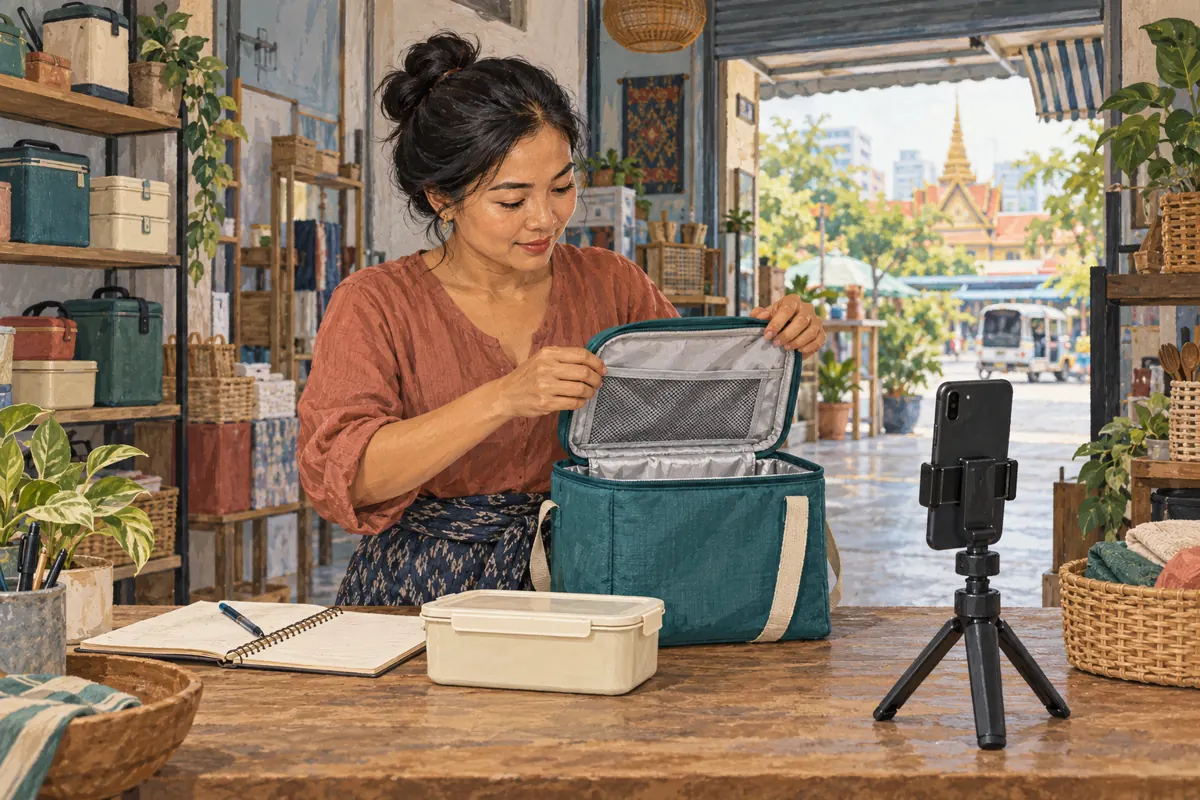
A lunch-bag video can show attractive colours and still leave the buyer’s main question unanswered: will their food container fit through the opening? For Cambodian shops planning TikTok promotion, choosing that question deserves attention before filming or considering an SMM-panel service. Search research can suggest what to explain, while conversations at the counter reveal the details customers actually need. This guide connects those two sources through a practical workflow: collect candidate questions, check their relevance, demonstrate one answer and review genuine enquiries. The running example is a hypothetical Phnom Penh lunch-bag shop; its products, customer questions and editorial decisions are illustrative, not reported business results.
1. Begin with a decision the buyer needs to make
In the hypothetical shop, the owner has two bags that look similar when photographed from the front. One opens across the top; the other has a lid that folds back. A customer carrying a rigid lunch container needs to understand the opening, usable space and closure. A colour montage may introduce the range, but it cannot settle those practical questions.
Write the buyer’s decision in one sentence before researching: “Can I use my existing container with this bag?” Then list the uncertainties behind it, such as lid clips, container height and room for a separate utensil case. Choose a question you can answer with the actual stock on your table. This gives the research a useful boundary. A popular topic about elaborate meal preparation may have little value if your shop sells bags and cannot offer a credible demonstration of the food preparation itself.
2. Check whether Creator Search Insights is available
TikTok’s official introduction describes Creator Search Insights as a tool for discovering frequently searched topics, including a content-gap filter for topics covered by relatively few videos. It documents finding the tool by entering “Creator Search Insights” in TikTok search. The announcement specifies availability in selected regions; it does not establish access for every Cambodian account. See the official source listed below.
Try that search in your own app and look for the actual tool entry. A tutorial appearing in search results is not the tool itself. If it is unavailable, continue with ordinary searches and questions your customers have voluntarily asked. Label these as manual observations. You can still make a useful demonstration without a trend score. Avoid borrowing someone else’s screenshot and presenting it as research from your shop’s account, or treating an absent feature as a reason to postpone an otherwise clear product explanation.
3. Collect a small set of questions with their context
Start with hypothetical research phrases such as “lunch bag for rectangular container,” “wide opening lunch bag” and “lunch bag with bottle space.” These are suggested starting points, not verified popular searches. If your customers usually communicate in Khmer, ask a fluent colleague to write natural equivalents using the words customers use. Keep an English product term only when it helps identify an item or matches actual customer language.
For each useful observation, record the phrase, language, date, where you found it and the problem it appears to describe. Distinguish a topic shown by Creator Search Insights from a question in a public comment or a conversation at the counter. Do not paste customer names or private message screenshots into the research sheet. A short anonymous paraphrase is usually enough. This record lets another staff member understand why the topic was selected without assuming every observation represents the same audience.
4. Put each topic through three practical checks
First, check relevance: does the question concern something your shop sells or can explain? Second, check evidence: can you show the answer using the exact product available? Third, check usefulness: will the answer help someone choose, compare or use that product? A candidate should pass all three before it becomes a filming task. Search popularity alone does not answer any of these questions.
For the hypothetical shop, “Does this opening accept a rigid rectangular box?” passes because staff can demonstrate it directly. “Which bag keeps lunch cold all day?” needs evidence the shop may not possess. Do not turn the second topic into a performance promise just because it sounds appealing. Record it as requiring substantiation, or choose a narrower topic about the bag’s visible compartments. Likewise, a content-gap label should prompt investigation; it is not proof of Cambodian demand, an absence of competitors or a guaranteed ranking opportunity.
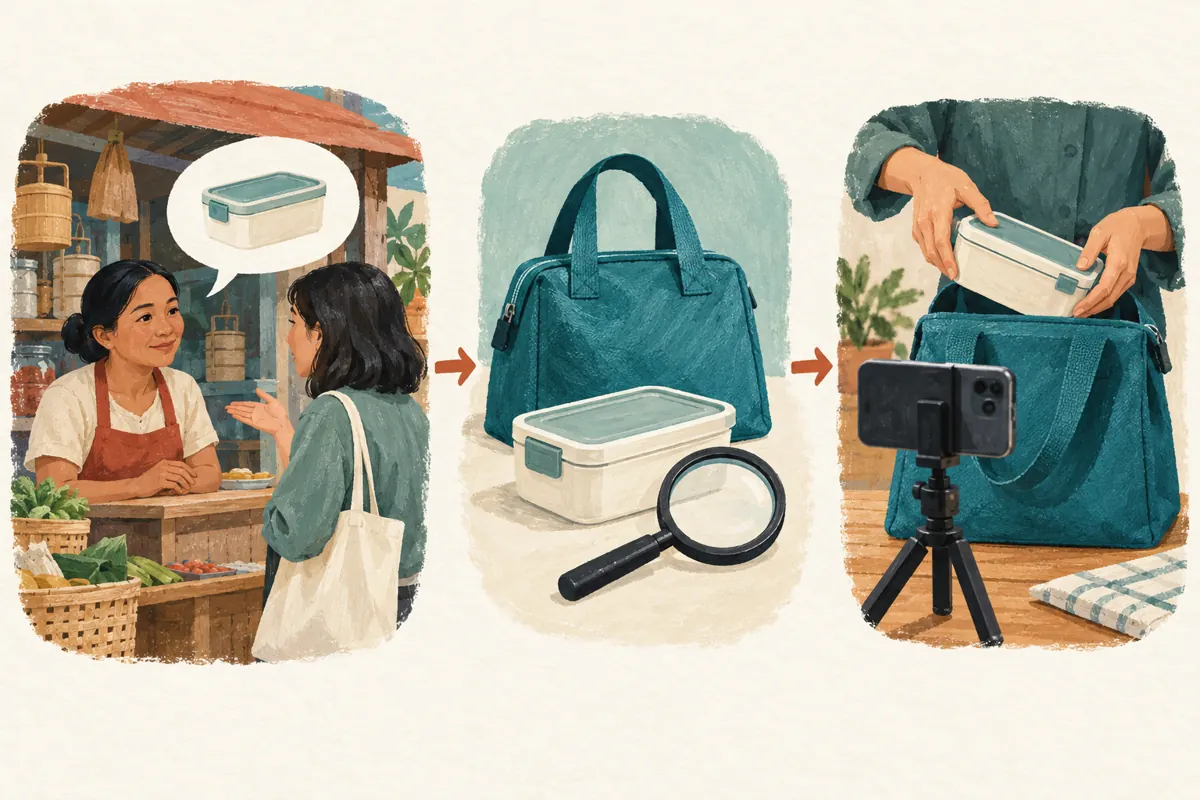
5. Turn the selected question into a demonstrable answer
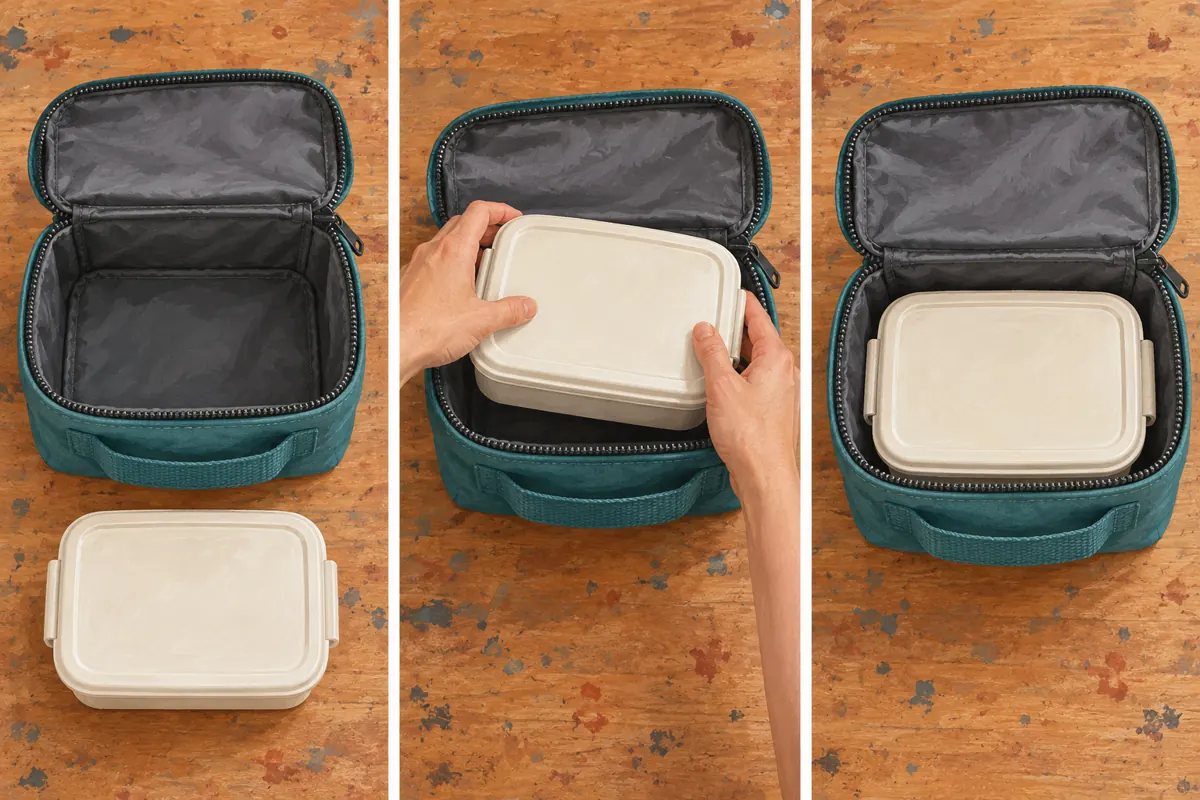
Prepare a short filming brief containing the question, bag identifier, container identifier, demonstration and limitation. For this hypothetical example, the demonstration is to show the container with its lid and clips attached, lower it through the fully opened bag and check whether the bag closes normally. The limitation is that the result applies to this combination, not every container sold under a similar size description.
Keep the critical movement visible. Start with the empty bag and container together, show the insertion without hiding the opening behind your hands, then show the closure. If you provide measurements, take them from the real items and identify what you measured. External bag width and usable opening width answer different questions. Include protruding clips when explaining container dimensions. A practical video should let viewers see why something fits, rather than requiring them to trust a broad “large capacity” claim.
6. Make the explanation usable for Cambodian customers
Choose the spoken language around the customers you intend to serve. A shop answering mostly Khmer enquiries can explain the fit in Khmer while retaining a genuine model name where needed. Keep the opening question, visible demonstration and caption consistent. A caption about bottle storage should not lead to a video that only demonstrates the main compartment. Ask a colleague to watch once and state what the clip actually proves.
End with a specific next step, such as asking customers to send their container’s length, width and height with the lid attached. Explain that staff will check the relevant bag before confirming suitability. Include pickup or delivery information only when it is settled. TikTok’s Help Center says commercial-content disclosure is required when promoting your own business as well as qualifying third-party promotions. Use the appropriate disclosure setting for the shop’s product video; an instructional format does not remove its promotional purpose.
7. Keep panel listings out of the demand test
The supplied public catalogue includes “TikTok Video Save ~ Max Unlimited ~ 10M/days ~ Instant ~ 𝐍𝐎 𝗥𝗘𝗙𝗜𝗟𝗟”. Its title identifies a video-save offering, but the supplied description is empty. The title’s capacity, timing and refill wording should not be treated as independently verified delivery facts. Nothing supplied establishes Cambodian audience origin, purchase intent or official TikTok affiliation.
For this workflow, buying saves would not validate the selected question. Purchased engagement is not evidence of genuine interest, sales, advertising delivery or Cambodian users. It would also complicate any attempt to interpret subsequent engagement as an audience response to the demonstration. TikTok’s official integrity guidance prohibits services that artificially increase engagement. The sensible decision is to decline artificial engagement for this research exercise. A catalogue listing can be documented as something reviewed without becoming a purchase recommendation or a reason to promote the video.
8. Review three separate kinds of evidence
Keep topic research, content observations and customer enquiries in separate parts of your review. Topic research explains why you filmed. Content observations describe what happened around the post, using only information actually available to you. Customer enquiries describe specific needs, such as a request to check a container with projecting side clips. None of these records should silently substitute for another.
Set a review date before posting so the team knows when to discuss the result. Record the published link and any changes made during the review period. If advertising or another promotional activity occurred, note that context too. Do not assign every later enquiry to the video unless there is a reasonable basis, such as the customer identifying it. Where earlier purchased activity may affect a metric, label the uncertainty instead of attempting to calculate a precise organic remainder from incomplete information.
9. Use the response to choose the next explanation
Imagine that the hypothetical shop receives a question about whether a bottle can stand beside the container. That suggests a distinct follow-up demonstration using the same identified bag, the container and a specified bottle. It does not prove the first clip failed. The first answer may simply have helped the customer reach their next practical question. Build the follow-up around that uncertainty rather than repeating the original demonstration with a different soundtrack.
Other responses call for different actions. Repeated confusion about which bag was shown suggests clearer identification. Questions about collecting an order suggest the next-step information needs work. No enquiries leave several possibilities open, including limited exposure, unsuitable stock or a question that was already answered sufficiently. Avoid declaring that customers do not want lunch bags. Choose one plausible improvement, document the reason and review it separately so the team can learn something from the change.
10. Avoid mistakes that make the research less useful
The easiest mistake is choosing the most exciting phrase and forcing the product into it. Another is copying a competitor’s script instead of identifying the question behind it. Use research to discover uncertainties, then create your own demonstration with your own stock. Keep product variants visible and do not switch to a larger bag midway through the sequence without explaining the change.
Also avoid filling the caption with every phrase collected during research. One clear question and a truthful answer give viewers a coherent reason to watch. Preserve practical qualifications when shortening the edit, especially distinctions between the opening, internal space and closure. Finally, do not present these article illustrations as product tests or customer evidence. They explain the workflow. The shop’s eventual promotional video should show the actual items customers can ask about, with claims limited to what staff can support.

Frequently asked questions
Does Creator Search Insights confirm that Cambodian customers want this product?
No. A displayed topic is a research lead, not proof of local purchase demand. Compare it with questions from the customers you serve and check whether your stock can answer the need. Do not describe a topic as Cambodian demand unless the evidence actually supports that geographic conclusion.
Can we use this workflow if Creator Search Insights does not appear?
Yes. Start with ordinary searches and recurring questions from your shop. Record what you observed without assigning unsupported popularity scores. A clear demonstration of a common fitting problem can be useful even when you have no access to a specialised research feature.
Should we film in English because the research phrase is English?
The research language does not have to determine the presentation language. Explain the answer in the language your intended customers understand. Have a fluent reviewer check that the wording preserves the practical distinction, particularly whether you mean container dimensions, the bag opening or usable internal space.
Would purchased saves help establish that the demonstration is worth promoting?
They cannot establish genuine interest or local demand, and artificial engagement conflicts with TikTok’s integrity guidance. Review whether the demonstration answers its question, whether viewers raise relevant follow-up questions and whether enquiries identify a concrete product need. A save total alone cannot resolve those issues.
What should staff request when a customer asks whether their own box fits?
Request the container’s external length, width and height with the lid attached, including clips or handles that protrude. A clear product photo may help explain its shape. Check against the actual bag and communicate any uncertainty; dimensions alone may not reveal how a rigid container passes through a flexible opening.
Explore the current service catalogue, create an account, or ask a specific question through support tickets.
- TikTok Newsroom: Get inspired with Creator Search Insights
- TikTok Help Center: Promoting a brand, product, or service
- TikTok Community Guidelines: Integrity and Authenticity
Prepared with AI assistance. Illustrations explain the workflow and do not represent customer results.